
The Experience Trap: Why "Years Required" Filters Out High Performers
Most job descriptions still treat years of experience like a proxy for ability. Three years minimum. Five preferred. Senior candidates only. It is a filter so common that most hiring managers never question it, and so weak that the research behind it is almost embarrassing.
TALENT ACQUISITIONPEOPLE OPERATIONSHIRING STRATEGY
Paulo Barrelas
4/16/20266 min read


Most job descriptions still treat years of experience like a proxy for ability. Three years minimum. Five preferred. Senior candidates only. It is a filter so common that most hiring managers never question it, and so weak that the research behind it is almost embarrassing.
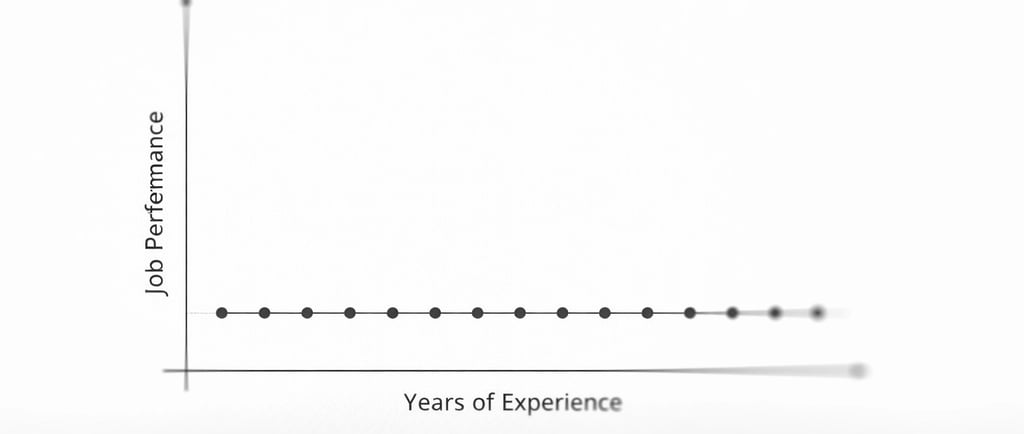
A meta-analysis examining over 80 workplace studies, conducted by Chad Van Iddekinge and colleagues at Florida State University, found a correlation of 0.06 between pre-hire work experience and job performance. That is not a moderate finding, open to debate. That is, for all practical purposes, no relationship at all. The same research found the correlation between experience and employee turnover to be 0.00, exactly. Years on the job predict neither how well someone will perform nor whether they will stay.
And yet over 80% of job postings list experience as a required or preferred criterion. A LinkedIn study found that more than a third of entry-level postings required 3 or more years of relevant experience, a logical contradiction so striking that it should have prompted a rethink of the whole system. It has not.
Time is not the same as value
The core problem with experience as a filter is what it measures: time. Not quality of performance. Not depth of learning. Not capacity to grow. Just the number of years someone managed to remain employed in a broadly similar role.
Two candidates can both present five years of experience. One spent those years actively building skills, seeking difficult problems, and developing judgment under pressure. The other spent them executing the same narrow set of tasks on autopilot. The job posting treats them identically. The hiring manager, relying solely on that filter, has no way to distinguish between them.
Research shows:
Van Iddekinge et al. (2019) found that simply being in a job at a previous organization says nothing about how well an applicant performed in that role. Experience counts time spent, not value created, which is precisely why it correlates with almost nothing worth predicting.
What predicts performance
If experience is a poor predictor, what should companies be looking at instead? The evidence from industrial-organizational psychology is remarkably consistent, accumulated over decades of research across thousands of roles and organizations.
Research shows:
Schmidt and Hunter's landmark 1998 meta-analysis, covering 85 years of personnel selection research across 19 different selection methods, found that structured interviews, work sample tests, and general cognitive ability significantly outperform years of experience as predictors of performance. Experience had a validity of 0.18. Structured interviews reached 0.51. Work sample tests reached 0.54.
More recently, Sackett and colleagues (2022) revisited this evidence with updated statistical methods and found that structured interviews, with a mean operational validity of 0.42, may be the single strongest predictor of job performance, ahead of cognitive ability. Job knowledge tests, empirically designed situational assessments, and work samples all outperformed years of experience by a wide margin.
What these methods have in common is that they assess what a person can actually do, not how long they have been doing something adjacent. That distinction is the whole argument.
Who gets filtered out
The harm of experience requirements is not evenly distributed. When companies demand years of experience as a minimum threshold, they disproportionately exclude people who were denied the opportunity to accumulate it, not people who lack the capability to do the job.
Career changers, people returning from caregiving breaks, candidates from under-resourced backgrounds, and recent graduates applying for roles just slightly above entry level all face a gate that has no meaningful relationship to their ability to perform the role. The screening criterion does not measure competence. It measures access to prior opportunity.
Research shows:
Van Iddekinge et al. (2019) explicitly noted that if applicants from protected groups have fewer opportunities to accumulate pre-hire work experience, relying on experience requirements can create an adverse impact that organizations will struggle to legally justify, given the weak correlation between that experience and actual performance.
This is the uncomfortable implication of the data. Experience filters do not just fail to identify the best candidates. They actively exclude high performers while giving the people running the process a false sense of rigor.


The trap compounds inside startups
For larger companies with established HR functions, bad hiring filters are an inefficiency. For startups with fewer resources, less margin for error, and a greater dependency on each individual contributor, they are more consequential.
A startup hiring for a role at 25 people cannot afford to spend three months chasing a candidate profile built on an experience threshold that predicts nothing, while a genuinely strong candidate moves to a company that screens differently. The cost of a misaligned hire, estimated at 50-200% of annual salary, depending on seniority, compounds the problem.
What experience requirements offer is comfort. They create the feeling that a filter has been applied, that standards have been set, and that the resulting shortlist is composed of qualified people. That comfort is real. The link between the filter and the outcome it is supposed to guarantee is not.
Building a hiring process that actually selects for performance means replacing the experience proxy with what the research recommends: structured interviews that ask consistent, behavioral questions scored against clear criteria; role-relevant work samples or skills assessments; and criteria defined around demonstrated capability rather than time served. None of these requires more money. They require a willingness to let go of a filter that has always felt credible, yet never been validated.
The years kept accumulating. The evidence was there. The habit just never broke.
Key Sources & Further Reading
Van Iddekinge, C. H., Arnold, J. D., Frieder, R. E., & Roth, P. L. (2019). A meta-analysis of the criterion-related validity of prehire work experience. Personnel Psychology. https://doi.org/10.1111/peps.12335
GetAura. (2024). Career progression trends: Insights into growth, promotions & exits. GetAura. https://blog.getaura.ai/career-progression-trends
Society for Human Resource Management. (2012). SHRM competency model. SHRM Foundation. https://www.shrm.org/credentials/certification/shrm-certification
Schmidt, F. L., & Hunter, J. E. (1998). The validity and utility of selection methods in personnel psychology: Practical and theoretical implications of 85 years of research findings. Psychological Bulletin. https://doi.org/10.1037/0033-2909.124.2.262
Sackett, P. R., Zhang, C., Berry, C. M., & Lievens, F. (2022). Revisiting meta-analytic estimates of validity in personnel selection: Addressing systematic overcorrection for restriction of range. Journal of Applied Psychology. https://doi.org/10.1037/apl0000994
The Seniority Problem
The hiring requirement is only half of the experience trap. The other half lives inside the organization, in the way seniority bands are structured. Most career ladders define progression by time, not capability. Junior means zero to two years. Mid-level means two to five. Senior means five-plus. The numbers are conventional, not research, and they have the same predictive relationship with actual performance as the years-required line on the job description: almost none.
This matters because the same structural logic that filters high-potential candidates out at the application stage continues to constrain them once they are inside. A candidate who outperforms peers within their first year is still categorized as junior because the system measures duration, not output. The promotion to mid-level or senior is not a recognition of demonstrated capability. It is a reward for time served.
Research shows:
A 2024 analysis found that organizations using skill-based career frameworks show 11% greater profitability and double the retention of high performers compared to those using tenure-based progression. The SHRM Competency Model, developed across research with 32,000 HR professionals, identifies nine core competencies that distinguish high from low performers at every career level, with no reference to years of service as a differentiating factor.
The gap between a seniority band and actual performance capability is not theoretical. I once hired a graduate directly from university into what the system would classify as a junior role. Within her first year, she consistently outperformed colleagues who had been in similar positions for over 3 years. The output was measurably better, the judgment was sharper, and the impact was visible to anyone paying attention. By the time of her first annual performance review, the recommendation was clear: she should be promoted to senior. The decision had nothing to do with time served.
What the experience requirement gets wrong at hiring, the tenure-based career ladder gets wrong inside the organization. Both instruments measure the same proxy, and both produce the same result: high-performing people constrained by a system designed around the average, not the exceptional.
Dropbox, Stripe, and Salesforce have all published competency-based career frameworks that explicitly decouple progression from tenure. Promotion decisions at these organizations are driven by demonstrated impact, breadth of contribution, and the ability to operate at the next level, not by the number of years an employee has been present. The frameworks are public because the argument is not proprietary. It is structural.


Contact
Reach out to start building your team culture.
About
Stay updated
© 2025. All rights reserved.