
The 6-Second Resume Screen: When Recruiters Gamble With People's Lives
There is a peculiar boast that circulates on LinkedIn with predictable regularity. Recruiters announce, with apparent pride, that they can scan a resume and decide a candidate's fate in five or six seconds. It is presented as a skill, a kind of superpower born from experience.
TALENT ACQUISITIONHIRING STRATEGYORGANIZATIONAL PSYCHOLOGY
Paulo Barrelas
4/4/20268 min read


A peculiar boast circulates on LinkedIn with predictable regularity. Recruiters announce, with apparent pride, that they can scan a resume and decide a candidate's fate in five or six seconds. It is presented as a skill, a kind of superpower born from experience. What it reveals is a profession that has, in many corners, stopped doing its job and built an entire economy around making candidates pay for that failure.
I know some recruiters actually read resumes to make sure they aren't missing anything that would excuse rejecting a candidate, but this article refers to the 5-second screening allegations that many admit to practicing.
Let's start with what research tells us.
The "6-Second Scan": Myth, Misuse, or Both?
A 2018 eye-tracking study by Ladders Inc. found that recruiters spend an average of 7.4 seconds on an initial resume screen (up from just 6 seconds in their 2012 study). This is the data point that spawned an industry of advice columns, YouTube channels, and resume-writing services, all promising to help candidates survive the gauntlet of a human being's attention span.
But here's what often gets omitted from those breathless LinkedIn posts:
Only 30 recruiters participated in the original study, and the updated 2018 version doesn't even specify the number. For context, approximately 39,000 staffing and recruiting offices were operating in the USA at around the same time. The study also didn't include the job specifications or the resumes being reviewed, which means key context is missing: the role's seniority and industry, whether the role had specific experience requirements, and how relevant or lengthy the submitted resumes actually were.
More critically, the study was never a definitive measure of how recruiters review resumes in the real world. It included a timed test and a lab environment, not a naturalistic observation of actual hiring workflows. When you do the math on the 7.4-second claim, you could theoretically clear nearly 500 candidates in an hour, so either the claim is true, and recruiters have ample time to do their jobs properly, or they're actually spending longer, which means the 6-second rule is simply a catchy myth that generates clicks and sells services.
A more grounded estimate from practitioners suggests that recruiters spend anywhere from 5 to 30 seconds on an initial review, with time significantly affected by volume, role seniority, and candidate relevance, and that once a resume passes the initial screen, recruiters return to it and spend considerably longer reviewing it in depth.
The "5-second rule" is not a professional standard. It is, at best, a volume-management reality that should embarrass the profession into fixing its processes. At worst, it is posturing, a way to signal expertise by describing a shortcut.


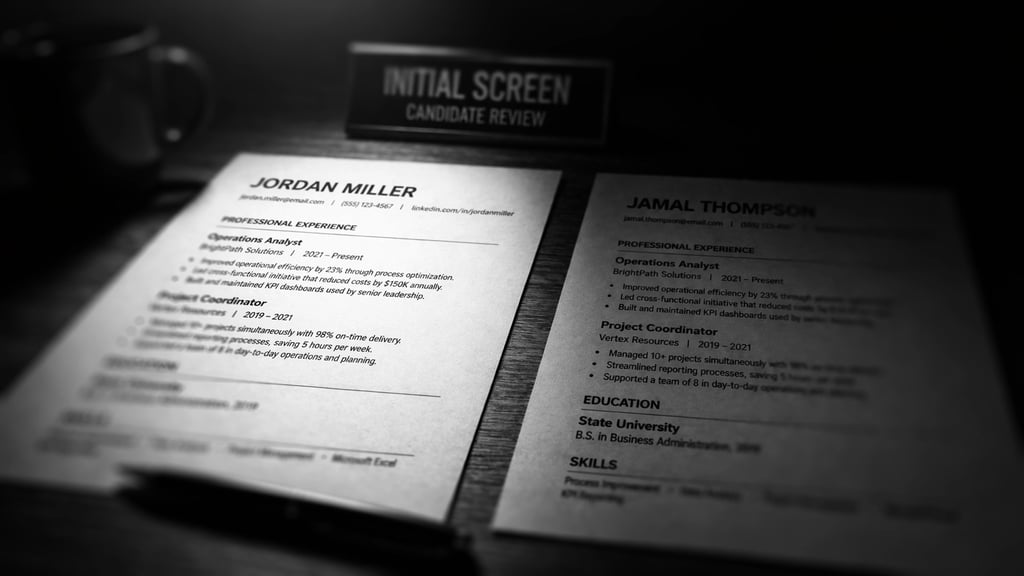
When a recruiter dismisses a resume in under ten seconds, they are not evaluating a candidate's potential. They are pattern-matching against unconscious assumptions. And the research on what those assumptions look like is damning.
A name discrimination study found that individuals with names more commonly associated with African-American culture are significantly less likely to receive interview callbacks despite having identical resumes to candidates with Caucasian-sounding names, and this effect persists in modern studies across multiple sectors. As researchers summarize the findings starkly: "Lakisha and Jamal" need 8 more years of experience on their resume to get the same interview callbacks as "Greg and Emily."
The pattern extends beyond names. A Harvard study found that when applicants from underrepresented groups "whitened" their resumes by removing references to race, 25% of Black candidates received callbacks compared to 10% who left their identities intact. For Asian applicants, 21% received calls with a whitened resume versus 11.5% without.
Research on educational prestige has found that hiring managers at elite firms can distinguish between target and non-target university candidates in under 6 seconds, and that this distinction drives a larger share of the screening decision than any specific qualification. In other words, the thing being assessed in those seconds often has nothing to do with whether someone can do the job.
Studies show that identical resumes receive different ratings depending on which piece of information the reviewer sees first. The same experience gets labeled "relevant" when attached to a strong school name and "insufficient" when the school name is unknown.
This is not a quality screen. This is a bias engine running at speed.
What Those Seconds Are Really Screening For
The Industry That Grew From This Dysfunction
Here is the perverse economics of the situation: because recruiters have either promoted or accepted the idea that resumes must survive a seconds-long glance, an entire industry has emerged to help candidates engineer documents that appease human cognitive shortcuts rather than honestly represent their experience.
The global resume writing service market was valued at approximately $2.5 billion in 2025, projected to reach $3.42 billion by 2029. That is a multi-billion-dollar industry that exists, in substantial part, because hiring gatekeepers are not evaluating candidates. They are evaluating formatting.
Candidates are increasingly told to hire professionals to write their resumes, not because their experience is insufficient, but because they haven't learned to package it in a way that survives a cognitive shortcut. The problem is not the candidate. The problem is the process. And the resume-writing industry is not the solution to that problem; it is the financial beneficiary of it.
To be fair, there is genuine craft in resume writing, and structured formats like the "Accomplished [X] as measured by [Y], by doing [Z]" model championed by Google do help candidates communicate impact clearly. These are genuinely useful tools. But useful tools for clear communication are very different from a mandatory tax on job seekers just to survive a broken screening process.


A Profession Without a Standardized Track
Part of the problem is structural. Recruiting is one of the few professional industries with no real standardized academic discipline or mandatory track that prepares someone for success in the field. There isn't one school, one definitive certification, or even one clear pathway into the profession. As one industry source bluntly puts it, people often become recruiters either by accident or out of necessity. Given an opportunity that involves recruitment activities, they may grow to enjoy the profession and move into talent acquisition full-time.
According to SHRM, over 75% of talent acquisition professionals say they need additional training to stay effective in their current role. That is not a damning statistic in itself, as every profession needs continuous development. But in a field where decisions made in under 10 seconds can eliminate qualified candidates from consideration, the gap between what recruiters are doing and what rigorous assessment actually requires is consequential.
Many leaders who conduct interviews never receive formal training in this critical skill, and without proper guidance, hiring decisions end up based on gut feelings and casual conversations, lacking clear direction on what to look for, what questions to ask, or how to evaluate responses. This applies equally to resume screening.
In addition to my MBA, I leverage over 25 years of experience and a commitment to the 'Golden Rule'—treating others with the same respect I expect in return. I am dedicated to continuous improvement by adopting best practices from industry peers, and I ensure a thorough approach by never spending less than a full minute on any initial screening.


The Human Cost of Treating This Casually
Work is not a commodity transaction. For most people, employment is how they maintain dignity, support their families, build identity, and contribute to something larger than themselves. The decision to reject a candidate is not a minor administrative act. It can alter the trajectory of someone's life.
When a recruiter dismisses a resume in five seconds based on formatting, font choice, or the absence of a bullet-point formula they prefer, instead of exercising professional judgment, they are gambling with someone else's livelihood on the basis of personal aesthetic preference.
The talent being filtered out is not marginal. In many cases, the strongest candidate in the pool triggers a cognitive shortcut in the reviewer. The reframe that research recommends is pointed: bias in hiring is not primarily a diversity program issue. It is a quality problem. A process contaminated by bias produces systematically inaccurate assessments of candidate quality.
There Is a Better Way: And Honesty Is Part of It
My background spans both operations and People Operations, and that combination has shaped how I approach hiring decisions. When you've also been responsible for what happens after someone joins — team dynamics, productivity, processes, outcomes — you develop a different relationship with the screening decision. You understand what it costs when it goes wrong, in ways that go well beyond a rehiring fee.
I have read every resume that has come across my desk. I have never excluded a candidate from a screening interview based on the structure of their document. What matters is what someone actually did, where, past achievements, and genuine potential, not formatting choices.
And I'll be direct about something else: I haven't always made the right call in hindsight. Candidates I hired with full conviction sometimes didn't perform as expected, even with proper onboarding and support. That's part of being human on both sides of the table. People are complex. Circumstances change. Training has limits. Accepting those realities is not a failure of process; it is intellectual honesty about what hiring actually is.
But there is a meaningful difference between a decision made carefully, on the basis of someone's full professional picture, that doesn't work out, and a decision made in five seconds on the basis of resume aesthetics that filters out someone excellent before they ever get a chance to speak. The first is an informed risk. The second is an uninformed one dressed up as expertise.
Structured, criteria-based screening (reading against the requirements of the actual role rather than against vague notions of what a "good resume" looks like) is both fairer and more effective. Blind screening, which removes identifying information such as name, educational institution, address, and graduation year, can significantly reduce bias in initial screening decisions. Technology, including well-designed AI tools trained without historical bias baked in, can help process volume without sacrificing quality.
The five-second screen is not a feature of a functioning hiring process. It is a symptom of a broken one.
Companies that take talent seriously, that understand the quality of their people is the primary determinant of their performance, cannot afford to outsource candidate assessment to cognitive shortcuts and resume aesthetics. The bar for professional rigor in hiring should be at least as high as the bar for professional rigor in any other business-critical function.
People deserve that. And organizations, if they're honest with themselves, need it.
Key Sources & Further Reading
Ladders (2018). Eye-Tracking Study. https://www.theladders.com/static/images/basicSite/pdfs/TheLadders-EyeTracking-StudyC2.pdf
O'Donnell, R. (2018). "Eye-Tracking Study Shows Recruiters Look at Resumes for 7 Seconds". HR Dive. https://www.hrdive.com/news/eye-tracking-study-shows-recruiters-look-at-resumes-for-7-seconds/541582/
Distinct Recruitment (n.d.). "The 6-Second CV: Recruitment's Biggest Myth". https://www.distinctrecruitment.com/uk/resources/blog/the-6-second-cv-recruitments-biggest-myth/
Fennell, A. (2025). "How Long Recruiters Spend Looking at Your Resume". Standout CV. https://standout-cv.com/usa/stats-usa/how-long-recruiters-spend-looking-at-resume
PMC (2022). "Mitigating Bias in Recruitment". National Institutes of Health. https://pmc.ncbi.nlm.nih.gov/articles/PMC9436705/
Cardone, B. (2026). "Bias in Hiring: Glossary 2026". Avua. https://blogs.avua.com/glossary/bias-in-hiring/
Low, C. & Kessler, J. (2019). "Uncovering Bias: A New Way to Study Hiring". Knowledge at Wharton. https://knowledge.wharton.upenn.edu/article/uncovering-hiring-bias/
Hilgers, L. (2021). "5 Ways to Reduce Bias When Screening Candidates". LinkedIn Talent Blog. https://www.linkedin.com/business/talent/blog/talent-acquisition/ways-to-reduce-bias-when-screening-candidates
Hyring (n.d.). "Confirmation Bias in Hiring". https://hyring.com/free-hr-toolkit/hr-glossary/confirmation-bias
Research and Markets (2026). "Resume Writing Service Market Report". https://www.researchandmarkets.com/reports/6089779/resume-writing-service-market-report
Paycor (2020). "Are Recruiting & HR Certifications Worth It?" — https://www.paycor.com/resource-center/articles/are-recruiting-hr-certifications-worth-it/
McConnell, B. (2025). "8 Recruiting Certifications to Try Today". Recruitee. https://recruitee.com/blog/recruiting-certifications
RecruitBPM (2026). "Top Recruiter Courses & Certifications 2026". https://recruitbpm.com/blog/best-courses-for-recruiters-boosting-your-recruitment-skills
eCornell (n.d.). "Recruiting and Talent Acquisition". https://ecornell.cornell.edu/certificates/human-resources/recruiting-and-talent-acquisition/
Becca, C. & Moore, C. (2023). "Improve Decision-Making in Hiring: Common Pitfalls and How to Avoid Them". Harvard Business School. https://www.hbs.edu/recruiting/insights-and-advice/blog/post/improve-decision-making-avoid-pitfalls-in-hiring


Contact
Reach out to start building your team culture.
About
Stay updated
© 2025. All rights reserved.